
Market Audit · Public Audit Protocol · DeepTech | Feb 28, 2026 | 4 min read
When evaluating capital allocation, a polished narrative often masks structural cap table physics. To test this, we ran the first public AI judgment engine benchmark: 32 NASDAQ-DEEPTECH companies mapped through the askOdin Judgment Graph™.
The Clarity Score does not measure stock price. It measures structural coherence. Across the 32-company cohort, scores ranged from 57 to 98 — a 41-point spread that maps directly to observable business physics.
Our engine gave TSMC a 98. It gave Intel a 57. The spread between them — a $600B+ difference in market cap — maps to a 41-point Clarity Score gap.
The Terminal Output
| Company | Clarity Score | Verdict | Finding |
|---|---|---|---|
| TSMC | 98 | CLEAR | Total narrative and mathematical alignment. The gold standard. |
| AMD | 98 | CLEAR | Full narrative-math coherence. Strong execution matches strong story. |
| Palantir | 98 | CLEAR | Narrative and financials fully aligned. |
| Super Micro (SMCI) | 77 | INVESTIGATE | Accounting friction detected in the math. Engine calibrated without overcorrection. |
| Intel | 57 | WATCH | Narrative Gap of 12. Polished presentation cannot hide collapsing margins and CAPEX bleed. |
TSMC demonstrates total narrative and mathematical alignment. Intel reveals a Narrative Gap of 12 — a polished presentation that cannot mathematically hide collapsing margins and CAPEX bleed. The legacy penalty was applied clinically.
The Nuance Proof Point
The most important finding in the cohort was Super Micro Computer (SMCI).
A blunt, LLM-wrapper scoring tool provides binary answers — it gives a 95 or a 30. When the askOdin engine processed SMCI, it returned a 77 (INVESTIGATE). The compiler detected accounting friction in the math. It isolated the brittle assumptions without overcorrecting the underlying business momentum.
It smelled the anomaly.
This is the difference between an answer engine and judgment infrastructure.
A dumb scoring system gives 95 or 30. Ours caught the accounting friction without overcorrecting. This single finding separates judgment from scoring.
What the Engine Measures
The analysis is powered by the patent-pending RUNE Protocol™, which compiles 40+ data points into a structured audit across four dimensions:
- Story Quality — Logical consistency between narrative claims
- Market Evidence — Data provenance and mathematical alignment
- Unit Economics — Financial viability under stress conditions
- Team Signal — Execution capability against stated ambitions
We are not generating text. We are identifying compile-time errors in business physics.
The Risk Quadrant
When the full NASDAQ-DEEPTECH cohort is plotted by narrative strength versus mathematical integrity, clear clusters emerge.
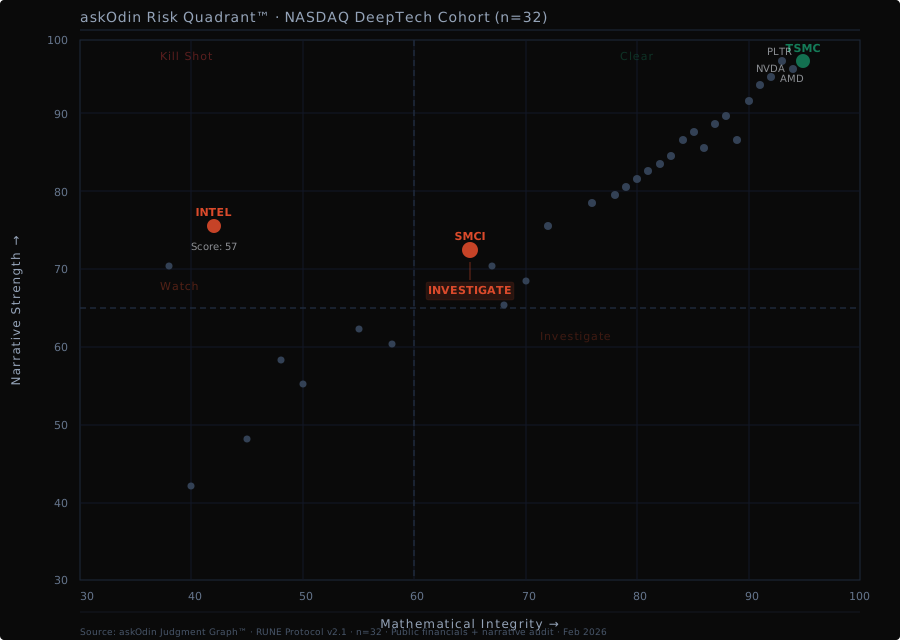
Companies separate into four quadrants:
- CLEAR (top-right): Narrative and math aligned. TSMC, AMD, Palantir.
- INVESTIGATE (middle): Signal detected. Requires deeper forensic review. SMCI.
- WATCH (bottom-right): Strong narrative, weak math. Intel.
- KILL SHOT (bottom-left): Terminal structural failure. Score collapses.
This is what a DeepTech capital allocator would see — an instant, auditable triage layer across an entire portfolio. Companies plotted by structural integrity, not narrative polish.
The Implication
Every seasoned General Partner does this analysis manually in their head. They read the narrative, check it against the math, and form a conviction. The problem is that this process is unscalable, unauditable, and inconsistent across partners. The average VC reviews 1,000+ decks per year. Manual narrative-math auditing at that volume is structurally impossible.
We made it systematic, auditable, and scalable. The 32-company benchmark completed in under 4 hours — the same analysis would take a 3-person team 2–3 weeks manually. That is what judgment infrastructure means.
askOdin provides judgment infrastructure, not investment advice. Clarity Scores reflect narrative-math alignment and structural coherence. They are not buy/sell recommendations. All companies referenced are publicly traded with publicly available financial data.
Founders: Test your own deck against the exact same engine. Isolate your brittle assumptions before you face GP scrutiny. Stress-test your deck free →
Allocators: The Audit Gap in venture capital closes here. See the infrastructure →
Related Reading
- What 134 Pitch Deck Audits Reveal About Deal Flow Quality — The private markets version of this analysis.
- Why the Best Founders Demand an Audit Gap Analysis Before They Pitch — The case for founder-initiated due diligence.
- What is AI Judgment Infrastructure? — The category definition.
- The 5 Compile-Time Errors That Kill Seed Rounds in 2026 — Structural flaws in private market narratives.