
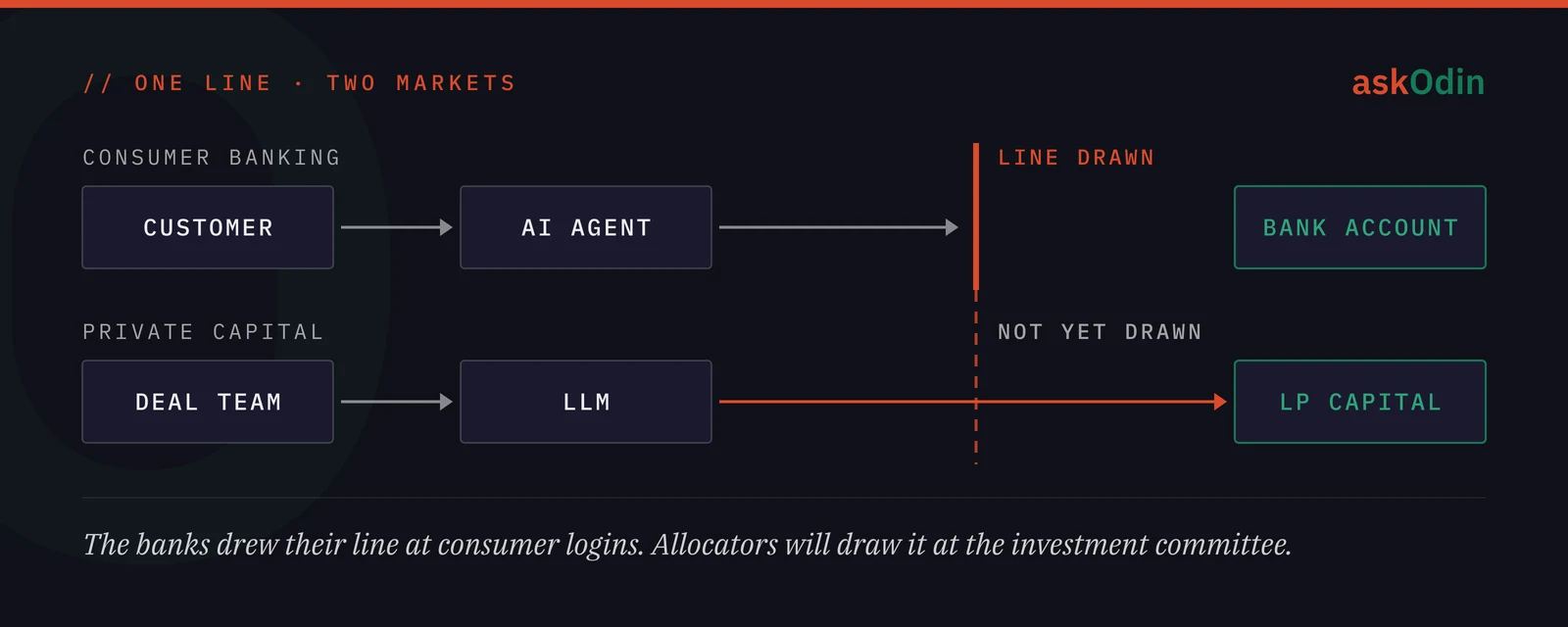
Canada’s largest financial institutions have drawn a defensive perimeter against autonomous software. RBC, BMO, and TD have blocked third-party personal AI agents from accessing their online banking environments, while CIBC and Scotiabank have restricted access or warned clients against sharing credentials. The question underneath all of it is AI agent liability: who pays when the agent gets it wrong?
BMO CEO Darryl White put it to consumers without hedging: “Don’t give your banking username and password.” RBC CEO Dave McKay framed the issue around system-level exposure: “As these systems become more autonomous, the stakes go up when something goes wrong… If AI is going to move beyond the frontier and into the broader economy, trust will matter as much as capability.”
The easy reading is that traditional finance is resisting AI adoption.
That reading is wrong.
This ban is not a rejection of artificial intelligence. It is an indictment of an unviable technical architecture. TD says it wants a future where “trusted AI agents” create value for clients. The banks did not draw a line against automation; they drew a line against unallocated liability.
Their public statements lead with security and privacy. The paperwork gets to the money. RBC’s internal memo cites “liability exposure.” The fine print on its client explainer lists sharing a password among the conditions under which it will not reimburse losses.
And that exact same line is heading straight for institutional private capital.
The architecture of the liability gap
Modern financial infrastructure runs on deterministic certainty. A clearinghouse does not settle a payment probabilistically; Visa does not authorize a transaction based on narrative persuasiveness. Either the ledger reconciles according to strict mathematical rules, or the process halts.
Current commercial AI agents operate on the opposite premise. They are probabilistic engines designed for fluency, synthesis, and persuasion. When an autonomous agent is handed credentials to interact with a balance sheet, three structural failures occur simultaneously:
- The Authorization Gap. There is no agreed protocol to verify whether an action executed by an agent was an explicit user instruction or an algorithmic interpretation.
- The Evidentiary Void. Probabilistic models synthesize; they do not compile. When an agent executes an erroneous command or transfers funds under flawed reasoning, it leaves no click-to-source audit trail of how it arrived at that verdict.
- The Unassigned Counterparty. When a probabilistic model hallucinates an outcome and destroys value, who bears the loss? The user? The foundation model provider? The financial institution?
Jeff McMillan, who ran firmwide AI at Morgan Stanley until March and now leads McMillanAI, told American Banker: “Payment law still applies, but there are no agreed standards yet for how a bank verifies an agent, what the customer authorized it to do, or who is liable when it goes wrong.”
Until those standards exist, letting an unguided agent execute financial transactions is negligence disguised as innovation.
The parallel to private capital
The liability gap in consumer banking is visible because the balances are liquid and the errors surface immediately.
In private equity and venture capital, the same failure mode is operating at scale, unstandardized and unmeasured.
Today, General Partners and deal teams routinely dump confidential data rooms, pitch decks, and financial models into probabilistic LLMs. They prompt the model to identify risks, evaluate unit economics, and synthesize investment memos. The model outputs a clean, articulate narrative. The investment committee reads the synthesis, assumes the diligence was rigorous, and wires eight figures of LP capital.
This is the institutional equivalent of handing bank login credentials to a consumer bot.
Large language models are narrative engines; they do not understand the physics of a cap table or the operational mechanics of burn rate. Nothing in the architecture forces them to distinguish an audited cohort retention curve from an ungrounded revenue projection. When a probabilistic tool produces an investment brief, it has not conducted due diligence. It has generated a fluent guess.
When an investment fails because a foundational revenue assumption was mathematically impossible from day one, what is the fund’s defense to its Limited Partners? That an LLM told them the cohort looked healthy?
Fluency is not analysis. Persuasion is not diligence.
Moving from narrative to judgment infrastructure
The Canadian banks understood what the venture ecosystem has largely ignored: the last mile of AI is not information retrieval. It is judgment.
The solution to rogue agents is not to ban software from finance. It is to put a deterministic layer beneath them, replacing probabilistic text generators with verification infrastructure.
Real institutional diligence requires software that operates like a compiler rather than a conversationalist:
- Deconstruct claims into assertions. Transform the prose in a memo, deck or model into structured, mathematically testable claims.
- Deterministic cross-examination. Stress-test assertions against balance-sheet physics, market size realities, and historical operating metrics, independent of the founder’s persuasive framing.
- Hard governance halts. A protocol that immediately halts and flags critical flaws (governance mismatches, cap tables that do not add up, broken unit economics) rather than smoothing over them to maintain narrative flow.
- Defensible Audit Log™. A sealed, mathematically traceable record of what evidence supported a conclusion, what constraints were tested, and how the verdict was derived.
Moody’s built an empire not by writing essays about debt, but by establishing a defensible methodology for rating credit risk. AI in private capital must meet the same institutional standard.
The four fiduciary questions for the AI era
If an investment committee cannot answer the following four questions about the automated systems evaluating its pipeline, the fund is carrying the same unallocated liability the Canadian banks just refused to carry. They belong beside the questions LPs should already be asking their GPs.
- What deterministic standard did the engine apply to this claim? Or did it merely summarize the founder’s narrative?
- Where is the click-to-source evidence trail? Can the model prove its assertion directly against primary financial documents?
- What happened when a load-bearing assumption failed? Did the system alert the committee to the structural flaw, or did it hallucinate a plausible rationale?
- Is the verdict reproducible? Run the same recorded inputs on the same methodology version tomorrow. Does the governance verdict stay identical?
These are not software questions. They are fiduciary questions.
The Canadian banks drew their line at consumer logins because the liability was immediate. Institutional allocators will eventually draw the same line at the investment committee table.
The only variable is how much unverified capital gets deployed before they do.
YekSoon Lok is the Founder & CEO of askOdin, building the AI Judgment Infrastructure™ for private capital.
See what the standard looks like on askOdin Clarity, or run a live audit in the sandbox.