
YekSoon Lok, Founder & CEO | Case Study · Forensic Diligence
September 18, 2026 | 7 min read
Theranos would have received a Clarity Score of 0 out of 100. That is what a reconstruction of its 2013 investor memo returns from the compiler: one physics violation, and the score floors to zero. The harder question is how so many sophisticated people missed it.
The Theranos board included Henry Kissinger, George Shultz, James Mattis, Sam Nunn and William Perry. Two former Secretaries of State. Two Secretaries of Defense, one former and one future. A former chairman of the Senate Armed Services Committee.
According to court documents made public in May 2018, the investors included the Walton family, the DeVos family, the Cox family and Carlos Slim. The 2023 restitution order in United States v. Holmes put Rupert Murdoch’s loss at $125 million, the largest of any investor named in it. Per the SEC, Theranos raised more than $700 million between late 2013 and 2015, at a valuation that peaked around $9 billion.
These were not naive actors. They had better information, better networks and better advisors than almost anyone reading this. They were defrauded anyway. Elizabeth Holmes and Ramesh “Sunny” Balwani were convicted in 2022, and the investors were the victims.
The issue was not intelligence. It was process blindness.
What the process saw
Theranos told a clean story. A proprietary device would run a comprehensive panel of clinical blood tests from a single fingerstick, at a fraction of what a conventional lab charges. The board carried national-security credentials. The founder was positioned as a Stanford dropout on a mission.
The presentation was competent, and competent is enough to get meetings and term sheets. That is the uncomfortable part. Nothing about the deck was amateurish.
What the process registered was narrative polish and social proof. What it did not register was whether the underlying claims could be true.
What the compiler saw
We ran a reconstruction of the 2013 Theranos investor memo through the RUNE Protocol™, the deterministic compiler that strips narrative polish and renders a business as a set of structural claims. It does not guess. It compiles.
The output was a Clarity Score™ of 0 out of 100.
That is not a low score. It is the floor. The compiler raised a Compile-Time Error and stopped.
The root cause was a physics violation. The memo claimed that a comprehensive multi-analyte clinical panel could be run on the blood from a fingerstick. A fingerstick yields around 50 microlitres. The immunoassay panel it described needs more than 500. That is an order of magnitude, and no amount of polish closes it.
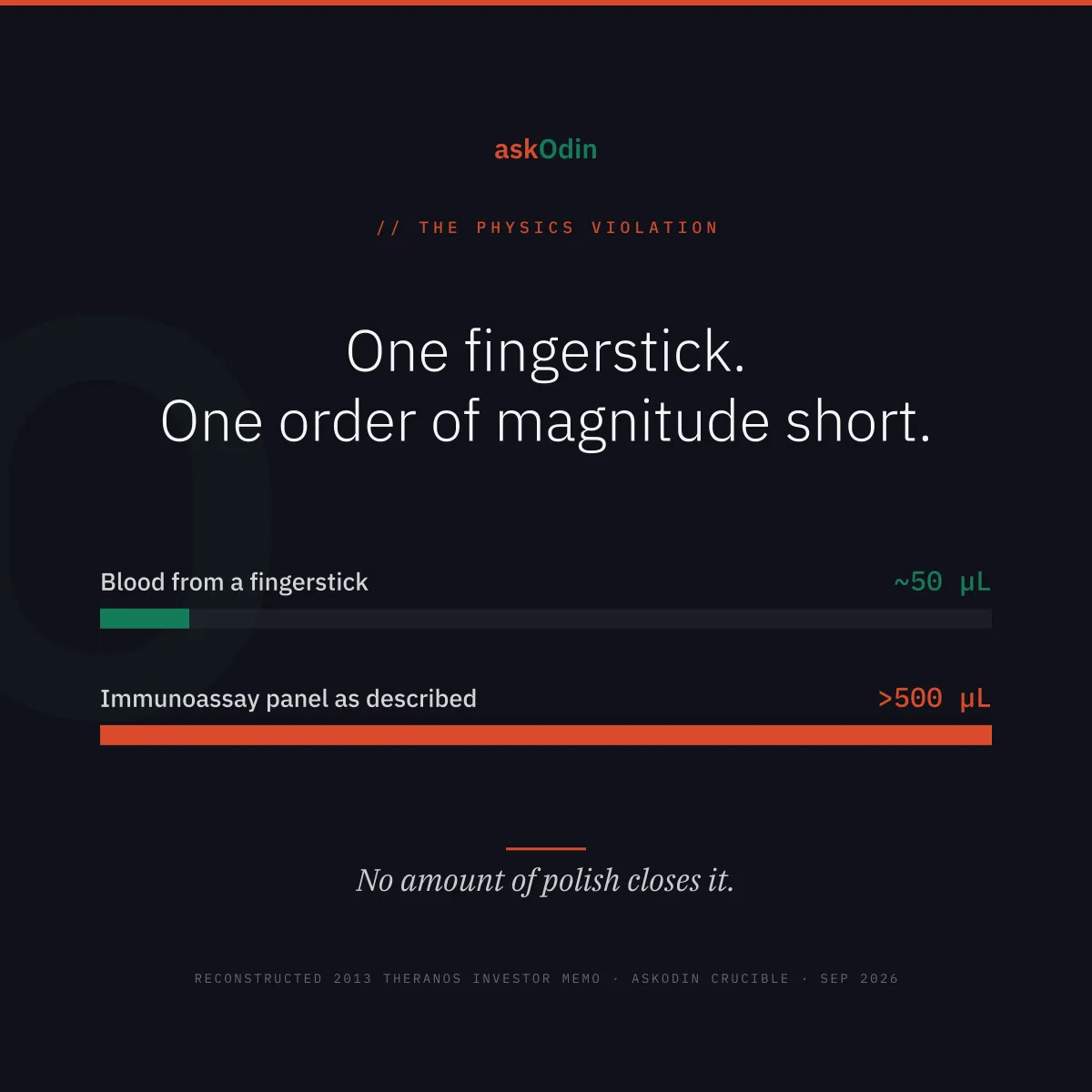
This is not a market opinion. It is a constraint on reagent volume, optical-path length and sample-to-cuvette ratios. The hardware footprint and unit economics in the same document did not fund the engineering it would take to bend those constants.
Here is the part that should worry anyone who signs off on a deal. The SEC complaint of 14 March 2018 found that Theranos ran the vast majority of patient tests on third-party commercial analyzers, not on its own device. The narrative and the operating model described two different businesses, and the signature of that gap was already in the memo.
The pillar-by-pillar breakdown
The Clarity Framework™ scores five pillars out of 20 each. Here is how the Crucible scored the Theranos memo:
| Pillar | Score | What it means |
|---|---|---|
| Problem Definition | 18 / 20 | The need was real. Pharmaceutical companies wanted to reduce adverse drug reactions and rescue the economics of clinical trials. |
| Solution Logic | 8 / 20 | Shrinking chemiluminescence assays to a point-of-care, micro-volume footprint was a theory. Nothing in the memo showed the hardware could do it. |
| Market Evidence | 10 / 20 | Board and investor credentials did the work that validation data should have done. Heavy signalling stood in for technical diligence. |
| Business Model Physics | 5 / 20 | The unit economics did not close. |
| Deal Structure | 4 / 20 | The size of the capital ask contradicted the stated commercial traction. |
The five pillars add up to 45, and the published score is 0. That is not an inconsistency. It is how the methodology works: when the engine finds a claim that cannot be true given the rest of the document, it floors the score to zero regardless of how strong everything else looks. A broken foundation does not get averaged against a good roof.
Notice where the memo scored highest. Problem Definition, 18 out of 20. The description of the market gap was accurate. The claims about capturing and defending the cash flow were structurally weak.
That shape is not unique to fraud. It is the shape of the market. Across the 2,488 decks in our 2026 benchmark, 17.9% scored below half marks on Problem Definition and 67.0% did so on Business Model Physics. Founders describe market gaps with precision. They are far less precise about how the money actually gets made.
The data consistency issue
The compiler caught a second signal, and this one is simpler.
The memo claimed $120 million to $1.5 billion in existing pipeline and $300 million in guaranteed 18-month revenue. It was asking for $10 to $15 million in new capital.
Here is the math. A company with $300 million of guaranteed revenue arriving inside eighteen months does not need a $15 million round. A company that needs a $15 million round does not have $300 million of guaranteed revenue. Both statements cannot be true at once.
Perhaps it was a definition error. Perhaps “pipeline” meant something generous. It does not matter. An investment committee reads it either as a data-quality problem or as a credibility problem, and either reading should have stopped the process.
The compiler flagged it. The process did not.
What the process missed
Not one of those board members was a clinician, an engineer or a laboratory scientist. John Carreyrou’s Bad Blood documents a board of statesmen and military leaders with no background in laboratory medicine. They were in no position to evaluate the technology. They saw a device that would save lives. David Boies, who later joined the board, was also the company’s outside counsel.
Theranos also stayed private, and a private company decides what its investors see. The usual market checks never had a chance to apply. The narrative was controlled.
The narrative was strong enough that the diligence it demanded never happened.
This is not a story about intelligence. It is a story about process. The deck looked competent. The board looked impressive. The founder looked visionary. The compiler looked at the physics.
The counterfactual
The interesting question is not whether a compiler would flag Theranos. The physics violation was in the document. So was the contradiction in the numbers. A compiler reads documents.
The interesting question is what the investment committee would have received instead of a gut check. A Clarity Score of zero stops the process at the first gate. A Defensible Audit Log™ records which claim broke which constraint, tied to the page it came from, as a sealed, mathematically traceable record. The committee gets a structural verdict, not a narrative impression.
The investors did not need hindsight. They needed a compiler.
The implication
Theranos is the canonical case. Every GP, LP and founder knows how it ends, which is exactly why it makes the argument better than any abstract thesis.
The framework is not about intelligence. It is about surfacing what the existing process does not see.
A good investment can come out of poor reasoning. A poor investment can come out of disciplined reasoning. The only way to tell which is which is to make the reasoning visible. That is what the Clarity Score does, what the Defensible Audit Log does, and what AI Judgment Infrastructure™ is for.
Venture capital is the last unaudited asset class. askOdin provides the infrastructure to close the gap.
Methodology note
This analysis uses a reconstruction of the 2013 Theranos investor memo, built from public-domain material. It is not the original file as circulated to investors. The same document drives the Theranos run in our sandbox, which also returns 0.
An earlier backtest audited the 2006 Series B narrative and returned a Clarity Score of 25 (The Theranos Backtest). Different vintages of the same company score differently. The 2013 memo makes explicit hardware and revenue claims that the 2006 narrative does not, and those claims are what trigger the floor. Methodology demonstration; not investment advice.
Sources: SEC Press Release 2018-41 (14 March 2018); DOJ indictment (15 June 2018); United States v. Holmes, N.D. Cal. 18-cr-00258 (verdict 3 January 2022; restitution order 2023); United States v. Balwani (verdict 7 July 2022); John Carreyrou, Bad Blood (2018).
This essay draws on the askOdin Terminal Audit of Theranos and the Crucible analysis of the reconstructed 2013 investor memo. For the underlying framework, read the SSRN working paper “The Last Mile of AI: Judgment Infrastructure, Defensible Audit Logs, and the End of Information Retrieval” (DOI 10.2139/ssrn.6664200).
Related reading: Terminal Audit: Theranos · The Theranos Backtest · How a Clarity Score compiles · The Taxonomy of Failure