
AI cognitive atrophy is the phrase that made the headlines. On the August 24 episode of Goldman Sachs’ Exchanges podcast, Chris Churchman, head of Marquee, the firm’s digital platform for institutional and corporate clients, and co-chair of its Global Banking & Markets AI Working Group, warned that “there’s a huge danger here that in the era of AI, we outsource our reasoning to these models, and we have cognitive atrophy that stops us being able to reason from first principles ourselves.”
CNBC and much of the financial press ran with that warning. It is a real concern, and Churchman made the case well: tools that do something better than we can erode the skill, the way wayfinding and memorization faded before them. Reasoning, he argued, is the skill that cannot be allowed to go the same way.
But the most important sentence in the episode came later, almost in passing.
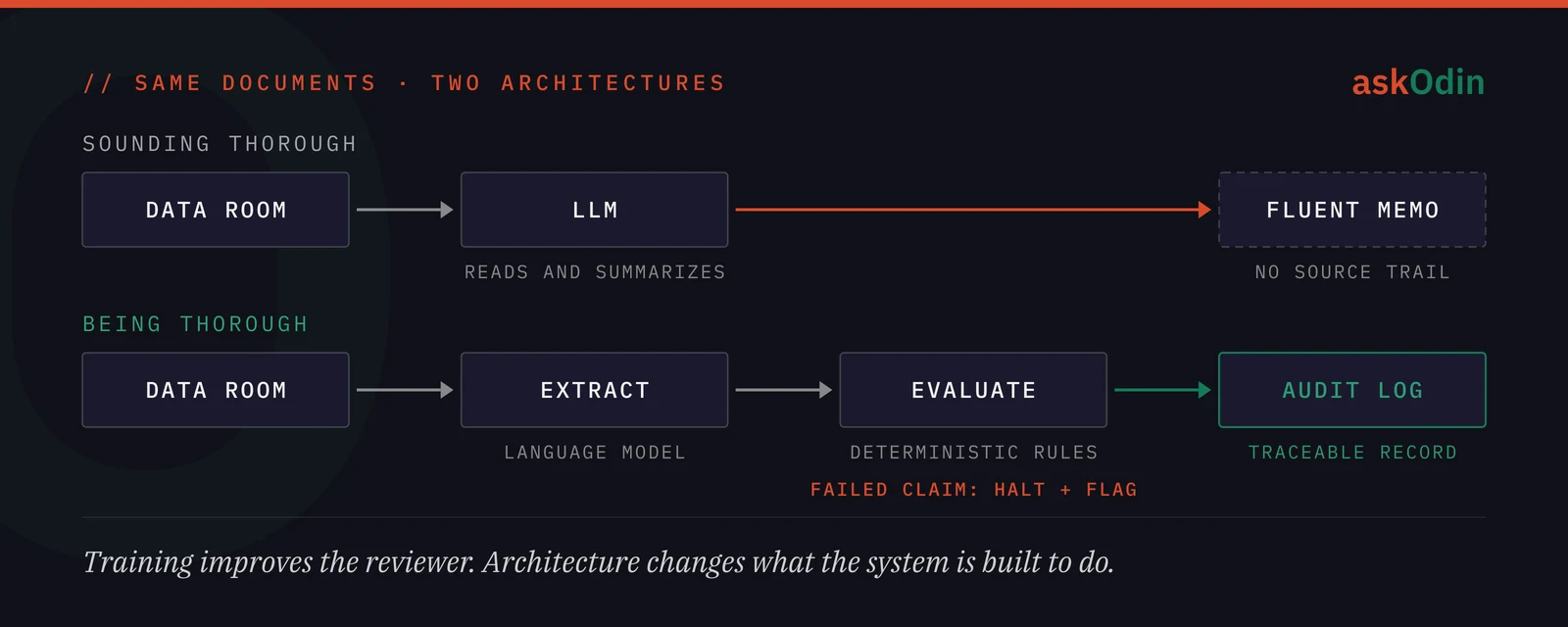
”Better at sounding thorough than being thorough”
Churchman was describing what it takes to build Marquee AI: attributing everything to a source, “a specific line in each source.” Off-the-shelf platforms list sources, he said, but web grounding does not actually use them. Then:
“And when we challenged it hard, at least it was honest. It was like, ‘Look, in the end, I’m better at sounding thorough than being thorough.’”
He did not stop at the anecdote. His next sentence was the diagnosis: “And so you really have to build the framework to force it to ground itself because it inherently can’t do it itself, and it’s not rewarded to either.” He pointed to the research behind it. A 2025 paper found that the way models are trained and scored rewards a confident guess over an admission of uncertainty.
That is a clear-eyed operator describing the frontier honestly. Read it as an engineer would, and it is also the most precise statement of the risk in institutional AI anyone at a bulge-bracket bank has put on the record.
The illusion of rigor
Large language models were not engineered to perform arithmetic, enforce balance-sheet constraints, or cross-examine credit covenants. They are probabilistic sequence engines, trained toward language that reads as authoritative, fluent, and complete.
In marketing copy or client correspondence, sounding thorough is enough.
In underwriting, sounding thorough is the most dangerous failure mode there is, because it is the one that looks like success.
When an investment committee works through a confidential information memorandum, the risk lives in the friction: the brittle assumption in a footnote, the capex schedule that does not square with the funding plan, the governance term buried on page 280 of the data room. Ask a conversational copilot to summarize that document, and it does exactly what it was trained to do. It produces a coherent narrative, smooths the inconsistencies into fluent prose, and returns an immaculate five-bullet briefing.
The analyst nods. The managing director skims. The deal advances.
Everyone assumes someone checked the plumbing.
Is AI cognitive atrophy the real risk?
It is a real risk. It is not the root one.
The headline version frames the problem as talent and training: how do you preserve tacit knowledge when algorithms do the first pass? Churchman himself pointed somewhere more structural. The question, he said, is “how do you build in such a way that our human capital can fully understand and stand behind the analysis that was generated by AI? And that has to be done in the design phase.”
That is the right answer, and it deserves to be taken further than the coverage took it.
Junior bankers and associates do not delegate reasoning out of laziness. They delegate because transaction workflows demand enormous throughput against closing deadlines that do not move. Hand an associate a copilot that turns 400 pages of diligence into a persuasive memo in a couple of minutes, then ask them to resist atrophy, and you are asking willpower to do the work of architecture.
Churchman put the arithmetic plainly. If a system is right 90% of the time, “the burden on you to figure out which of the 10 facts is fabricated? So you have to check all the facts.” A reviewer cannot know which 10% to distrust. So a tool that is mostly right does not halve the work of verification. It hides where the work is.
Here is the math. You cannot solve a verification failure by demanding more human stamina. You solve it by changing what the system is built to do.
From conversational copilots to judgment infrastructure
An institution that wants to protect both its people’s reasoning and its capital cannot rely on assistants that invite passive consumption of generated text. High-stakes capital allocation needs verification built into the architecture:
- Extraction must be decoupled from evaluation. A language model can read messy documents and pull out claims. It must never grade its own homework. Evaluation belongs to deterministic rules that apply the same constraints to every claim, every time.
- Assertions must be cross-examined, not summarized. If a pitch deck says the company is “fully funded to cash-flow breakeven,” the software should not repeat the bullet. It should test the claim against the financial model supplied with the deck (the burn, the runway, the capex plan), expose the gap, and flag the assumption carrying the weight.
- Traceability must be mathematical, not conversational. An analytical paragraph without a record of what evidence supported it is not diligence. It is an unhedged liability. A Defensible Audit Log™ is a sealed, mathematically traceable record of which evidence supported a conclusion, which constraints were tested, and how the verdict was reached.
None of this replaces the analyst’s judgment. It gives the analyst something worth judging: findings with sources attached, and failures that stop the process instead of disappearing into prose. That is how you keep reasoning in human hands. You stop asking people to audit fluency, and you give them evidence.
The same logic sits beneath the Canadian banks’ line on AI agents: automation without a verifiable record is a liability nobody has agreed to carry.
The fiduciary bottom line
Goldman Sachs’ own development work produced the clearest self-diagnosis the industry is likely to get: a model better at sounding thorough than being thorough. Its builder’s answer was to engineer the grounding the model could not supply itself.
Every institution putting generative AI into its diligence workflow faces the same choice. Either the framework forces the evidence, or the prose stands in for it.
LLMs optimize for persuasion. askOdin compiles for physics.
Venture capital is the last unaudited asset class. askOdin provides the infrastructure to close the gap.
YekSoon Lok is the Founder & CEO of askOdin, building the AI Judgment Infrastructure™ for private capital.
See what the standard looks like on askOdin Clarity, or run a live audit in the sandbox.