
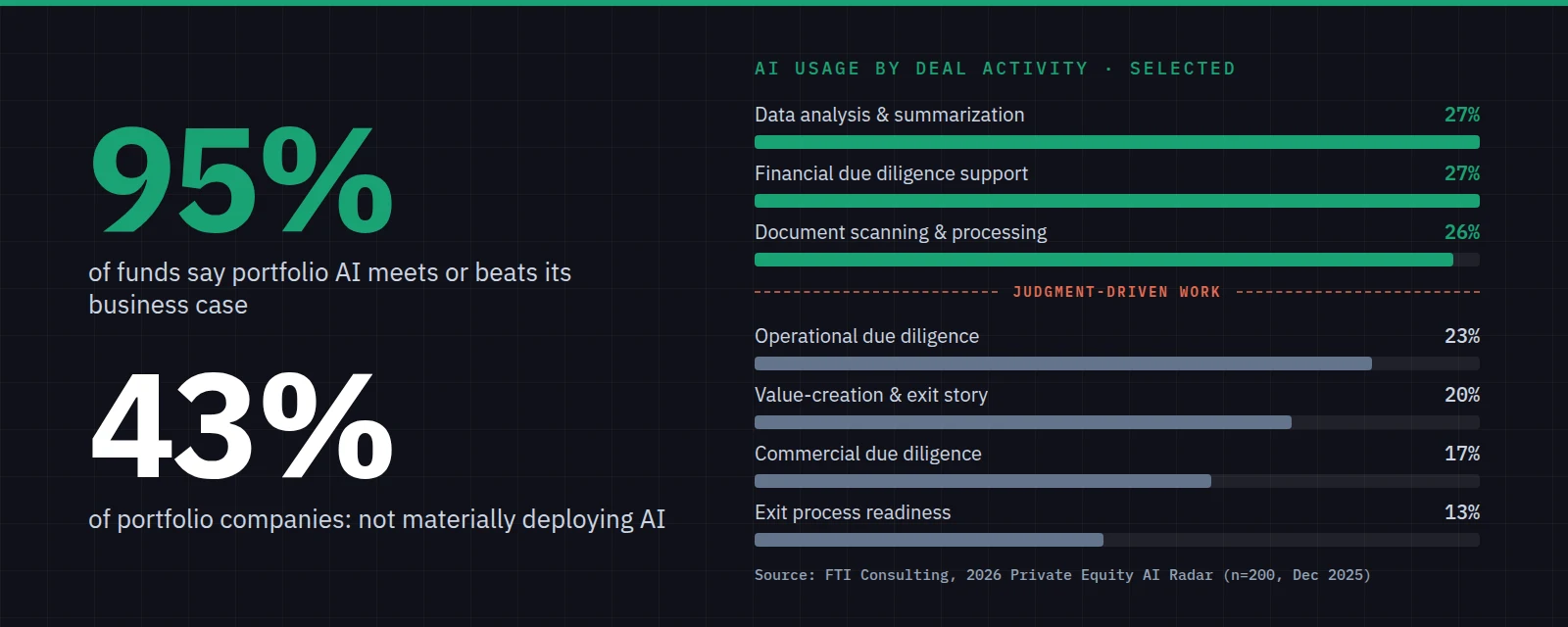
Private equity AI adoption has hit a ceiling, and it sits exactly where diligence stops being document work and starts being judgment. FTI Consulting’s survey of 200 senior PE decision-makers shows AI concentrated in summarization, financial diligence support and document processing, and thinnest in commercial diligence and exit work. The tools that took over the reading have not taken over the verdict.
FTI surveyed Managing Partners, Operating Partners, Principals and Vice Presidents at private equity firms with at least $1 billion under management, across North America, Latin America, Europe and the Middle East, in December 2025. The 2026 Private Equity AI Radar is worth reading in full. Two of its findings should be read side by side:
- 95% of funds report that AI initiatives across their portfolio companies are meeting or exceeding their original business case.
- 43% of portfolio companies are not materially deploying AI: 16% experimenting, 15% in limited use, 12% not using it at all. Only 7% have reached enterprise scale.
Both numbers are true. The tension between them is the current state of AI in private equity.
How can 95% be satisfied when 43% have not deployed?
Look at what the 95% is measured against. Most of those programs were designed to deliver a 5% to 10% improvement, which FTI notes is below the broader 15% benchmark for AI impact, and the report itself suggests many firms set “relatively conservative performance benchmarks at the outset.” Only 17% of funds say their programs significantly exceeded the business case.
Here is the math. A modest target, met, reads as success. It does not tell you the technology has reached the work that decides returns.
Where does adoption collapse?
FTI’s breakdown of AI use by deal activity shows where the software is doing the work, and where deal teams quietly leave it behind. Adoption is highest in the preliminary, document-heavy tasks: data analysis and summarization, financial due diligence support, and document scanning. As the work moves toward transaction risk and value realization, it falls to the bottom of the table.
Seven of the twenty activities FTI measured: the top three, and the diligence and exit work further down. The dividing line is our annotation.
- Data analysis & summarization 27%
- Financial due diligence support 27%
- Document scanning & processing 26%
- Judgment-driven work
- Operational due diligence 23%
- Value-creation planning & exit story readiness 20%
- Commercial due diligence 17%
- Exit process readiness 13%
Source: FTI Consulting, 2026 Private Equity AI Radar, Figure 14
FTI names the cause directly:
“AI adoption is currently stronger in front-end diligence and evaluation than in late-stage exit execution, likely because early-stage activities involve large volumes of structured data where AI can deliver immediate efficiency gains, whereas late-stage exit work is more customized and judgment-driven, making it less straightforward to automate.”
That sentence describes the ceiling. Generative AI has absorbed information retrieval. It stalls at judgment.
Why would adoption fall from 27% in document processing to 17% in commercial due diligence and 13% in exit readiness? Because commercial diligence and exit readiness are not synthesis tasks. They are adversarial verification.
Why does fluency fail in diligence?
Large language models, and the retrieval-augmented systems built on them, are probabilistic engines. They are optimized to produce fluent, coherent language. LLMs optimize for persuasion.
In preliminary research, fluency is an asset. In diligence, it is a liability.
Consider an illustrative mid-market deal. The Confidential Information Memorandum asserts a defensible 28% EBITDA margin driven by pricing power. Three hundred pages further into the data room, the seller’s own schedules show that 42% of the margin expansion came from one-time supplier rebates that expire within nine months.
Ask a language model to process that data room and it does what it was built to do: it produces an agreeable, highly readable paragraph that reconciles the two. It does not throw an error. It smooths the contradiction because it has no way to evaluate the business physics that make one of those claims false.
Private equity returns are not made by smoothing contradictions. They are made by catching them before capital commits. An investment committee does not need software that summarizes what management claims. It needs software that shows exactly where management’s narrative and the spreadsheet disagree.
That is the contradiction a pre-LOI check exists to surface: on the CIM and the financial schedules supplied with it, in under three minutes per audit, before the deal team signs an LOI or commissions the full quality of earnings work. The accountants still do the accounting. The triage tells them where to look first.
Is time-to-value the real bottleneck?
FTI’s respondents expect AI to pay back on a near-to-medium horizon: 38% expect measurable value in 7 to 12 months, and another 31% in 13 to 24 months. Asked what stops them scaling, they put AI talent first.
The five most cited of the ten barriers FTI measured.
- AI talent & skills shortage 35%
- Data readiness & accessibility 33%
- Time-to-value & deployment speed 29%
- Integration with legacy systems & technical debt 28%
- Organizational change challenges 25%
Source: FTI Consulting, 2026 Private Equity AI Radar, Figure 11
FTI reads that as an execution-capacity problem, and for portfolio operations it is. Deal work runs on a different clock. A buyout fund inside an exclusivity window cannot wait three quarters for a data program and a workflow redesign before its diligence tool produces its first verified finding. When the tool cannot keep up with the transaction, the deal team goes back to spreadsheets and junior analysts, and the software is left doing back-office summarization, where it meets modest expectations and changes nothing.
Who owns AI governance in private equity?
Execution sits with the portfolio companies: 56% of funds say delivery and implementation of AI use cases is PortCo-led, and FTI describes a hybrid model that broadly favors PortCo-led execution. But look at which functions the funds keep closest. AI governance, risk and compliance, and funding and budgeting, are each 29% fund-led, tied as the most centralized of the nine functions FTI measured. AI strategy and design is 26%.
Share of respondents placing the function at 1 or 2 on FTI's five-point scale, where 1 is fully centralized at the fund and 5 is PortCo-led.
- AI governance, risk & compliance 29%
- Funding & budgeting for AI 29%
- Performance tracking 28%
- Shared AI delivery teams 27%
- AI strategy & design 26%
- AI/ML tooling & model platforms 26%
- Vendor partnerships & ecosystem 25%
- Data infrastructure & platforms 24%
- Delivery & implementation of use cases 21%
Source: FTI Consulting, 2026 Private Equity AI Radar, Figure 10 (fund-led = scale points 1 and 2 combined)
That pattern is not an accident. Portfolio teams change. The general partner owns the fiduciary downside. If an acquisition fails because a diligence tool smoothed over churn disguised as deferred revenue, the loss lands at the fund, and the LPs hold the investment committee accountable, not the software vendor. Risk and the money are the last things a fund lets go of.
What are PE buyers paying for in AI?
When respondents evaluate AI-related acquisitions, a strong majority rate AI talent and technical teams (67%), proprietary data or AI infrastructure (57%), and product or platform AI capabilities (57%) as important or critical value drivers. Only 19% cite preventing competitor disruption.
Private equity buyers are unsentimental underwriters. They pay for the team, the data and the platform, not for a defensive posture. Our read, not FTI’s: a generic wrapper around someone else’s model has neither proprietary data nor a platform of its own, and buyers are pricing it accordingly.
How do the leading funds close the gap?
FTI calls the subset of funds pulling ahead the PE AI Alpha Tier: +6% stronger ROI realization, +5% greater cost savings and +4% more revenue growth than peers.
Alpha Tier vs. peers. Source: FTI Consulting, 2026 Private Equity AI Radar.
Crucially, the authors report that AI spending is broadly similar across tiers. What sets these funds apart, in FTI’s words, “is not how much they invest in AI. It is where and how they deploy it.”
For diligence, we think “where and how” comes down to three changes in architecture:
- From probabilistic synthesis to deterministic verification. A diligence system should audit reasoning, not predict text: cross-examine the narrative against the financial model and trace each contradiction to the cell and the page it came from.
- From multi-quarter integration to the documents as delivered. Underwriting cannot wait for a data-cleaning project. The check has to run on the memo, model and CIM the deal team already has, in minutes.
- From consensus to contradiction. Software built for capital allocation must never smooth over conflicting claims. A mathematical or logical discrepancy is a hard flag, not a sentence to be reconciled.
That premise is what askOdin Clarity is built on. It does not summarize a data room. It is AI Judgment Infrastructure™: a deterministic check of whether a memo’s or a CIM’s claims survive the model and documents supplied with them, before the committee votes. For private equity it is pre-LOI triage, run on CIMs as a scoped pilot. It does not replace the quality of earnings work that follows.
The first generation of enterprise AI organized data. The second summarized text. The funds that move into the Alpha Tier will be the ones that verify judgment.
Source. FTI Consulting, 2026 Private Equity AI Radar: Continued AI Acceleration and Impact (PDF). Online survey of n=200 senior private equity professionals (managing partners, operating partners, principals and vice presidents) at firms with AUM of at least $1 billion in North America (120), Latin America (30), and Europe and the Middle East (50), conducted in December 2025. All figures above are FTI’s; the interpretation is ours.