
AI infrastructure IPO due diligence fails in a specific way.
The documents are fluent and the numbers are large. Every slide holds up when you read it on its own. The contradictions sit between the pages, and a reader who goes page by page never sees them.
We could not show you this on a live deal. Late-stage data rooms are sealed under non-disclosure agreements, so the public post-mortems allocators would learn from do not exist.
So we built one.
Halvard Computing is a fictional AI neo-cloud: GPU data halls, an anchor accelerator vendor, a contracted-revenue story and an A$41.1bn IPO. We used Claude, Anthropic’s model, to draft the whole data room. That was fifteen files: the IPO investor presentation, the financial model, the cap table, a contract and site schedule, board minutes, an independent engineer’s report, a power purchase agreement summary, management’s answers to diligence questions and the rest of what a syndicate would expect to see.
It looked institutional. It read like a deal a syndicate desk would market.
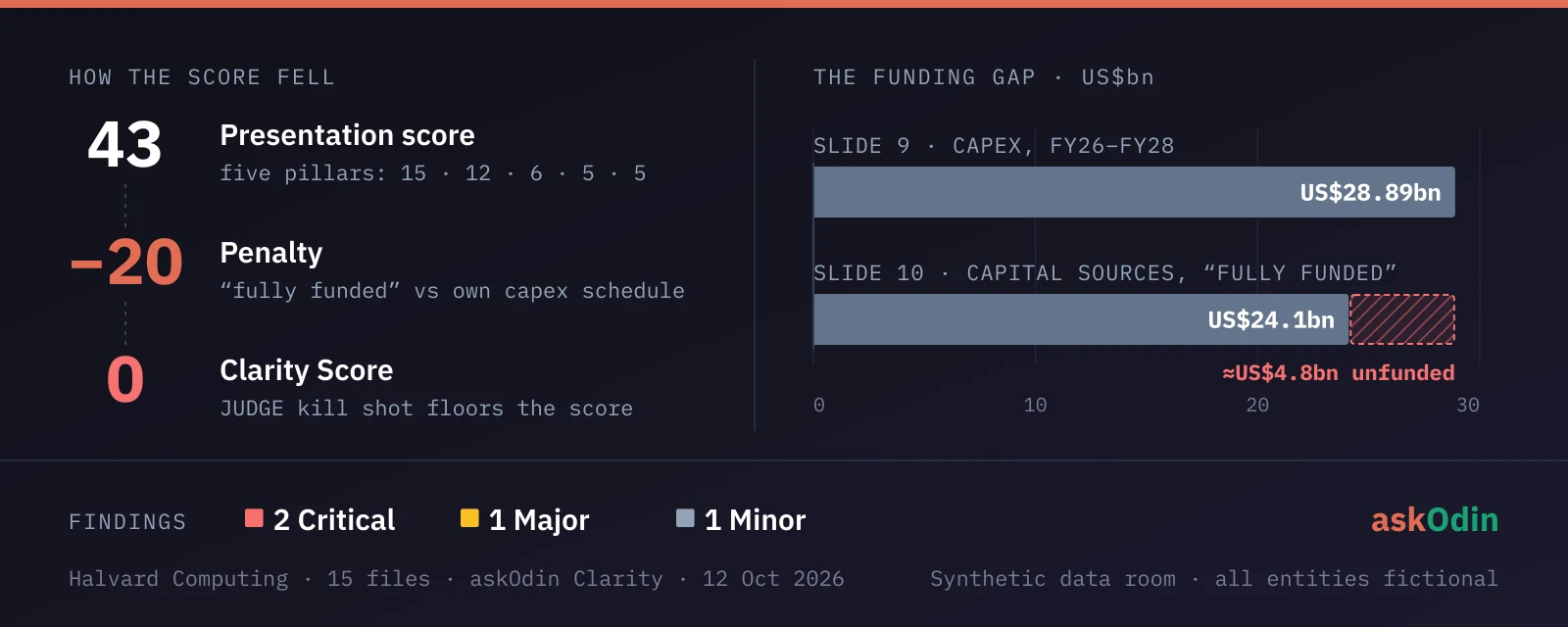
Then we ran it through askOdin Clarity. On presentation, the primary deck scored 43 out of 100. Once the engine checked the deck’s numbers against each other, the Clarity Score came back 0.
Halvard Computing, Aurelion, and every site, contract and counterparty named below are fictional. Any resemblance to a real company is unintended.
The audit at a glance
- Data room
- 15 files · 12 PDF, 3 XLSX
- Primary document
- 01_Investor_Presentation_IPO_Sep2026.pdf
- Presentation score
- 43 / 100
- Penalty
- −20 · “fully funded” asserted against the deck’s own capex schedule
- JUDGE override
- Narrative Masking · kill shot
- Clarity Score
- 0 / 100
- Findings
- 2 Critical · 1 Major · 1 Minor
- Next step, as the brief states it
- Reject allocation. Flag the “fully funded” assertion to the syndicate desk.
Here is the math. The five pillars scored 15, 12, 6, 5 and 5 out of 20, for a presentation total of 43. The engine deducted 20 points for the funding gap, which would have left Halvard at 23, already in the bottom band.
It never got there. The JUDGE Protocol™ (U.S. Prov. Patent 64/017,488), the engine’s runtime circuit breaker, found a kill shot in the primary deck. A kill shot floors the score to 0, however well the rest of the story is told.
| Pillar | Score | Findings filed |
|---|---|---|
| Problem Definition | 15 / 20 | none |
| Solution Logic | 12 / 20 | Unfunded capex programme · Operating capacity |
| Market Evidence | 6 / 20 | ”Contracted” pipeline |
| Business Model Physics | 5 / 20 | Vendor financing |
| Deal Structure | 5 / 20 | none |
Look at the shape before the findings. Halvard explains the market problem well: AI labs need power and accelerators, and supply is short. It explains how it makes money badly. That is the pattern we measured across 2,488 pitch decks, and an IPO book does not escape it.
Ten of the twelve narrative documents also scored 0 when the engine read them one at a time. One file needed no engine at all: the data room contains a bookbuild report that ends in a withdrawal.
The four findings
Critical: the “fully funded” build is US$4.8bn short
Slide 10 lists capital sources of roughly US$24.1bn and says they “fully fund” the build through FY28. Slide 9, in the same deck, shows FY26 to FY28 capex of US$28.89bn.
That leaves about US$4.8bn with no stated source.
This is not a debate about growth assumptions. Two numbers in the same document cannot both be true. It is also the finding the 20-point penalty was charged for.
Question for IC: How does management call the FY26–FY28 build “fully funded” when its own capex schedule needs nearly US$5bn more than it has raised or plans to raise?
Critical: “contracted” revenue is not all contracted
Slides 2 and 5 promote US$14.4bn of “contracted revenue.” Footnote 1 says that figure includes non-binding “heads of agreement” and “partner-supported offtake programmes.”
A non-binding heads of agreement records intent. It does not oblige anyone to take capacity, and nobody pays damages when a counterparty walks away. Putting it in the headline number and the caveat in a footnote is an old move. It works on anyone who reads slides rather than footnotes.
Question for IC: What is the net dollar value of executed, binding take-or-pay contracts once every MOU, heads of agreement and partner-supported indication of interest is stripped out?
Major: the vendor financing runs in reverse
Slide 7 says Aurelion, the accelerator vendor, provides credit support, worth roughly US$10bn, so that Halvard can deploy hardware “without full upfront purchase.” Slide 13, the use of proceeds, sends 62% of the IPO’s primary raise to Aurelion for accelerators for Bintan Phase 1.
Both cannot be the plan. If the vendor is financing the hardware, public equity should not be paying the vendor upfront for it. If public equity is paying upfront, the capital-efficiency story on Slide 7 is not the story. The brief puts the consequence plainly: if this prices, public investors absorb the funding gap while the anchor partner is paid out of their money.
Question for IC: If Aurelion’s vendor financing covers upfront hardware, why does most of the IPO’s primary raise go straight to Aurelion for upfront hardware?
Minor: the megawatts do not add up
Slide 6 shows 48 MW operating: 12 MW at Glen Esk and 36 MW in Sydney. Slide 9 shows 0 MW energised at the end of FY25A and 30 MW at the end of FY26A.
On its own this is the smallest finding, which is why it is Minor. In a business whose revenue is energised megawatts, it is also the first number a public-market analyst checks.
Question for IC: Why does the footprint slide claim 48 MW of operating capacity when the deck’s own financial summary shows at most 30 MW ever energised?
Why would a general-purpose AI summary miss it?
Read each slide alone and Halvard passes. Slide 10 is a clean capital-sources table. Slide 5 states a large backlog with confidence. Slide 7 describes a sensible vendor partnership.
A summariser, human or machine, reports what each page says. On each page, what it says is fine.
The problems only exist between the pages:
- Slide 10’s capital against Slide 9’s capex.
- Slide 5’s headline against Slide 5’s footnote.
- Slide 7’s vendor credit against Slide 13’s use of proceeds.
Finding them takes cross-examination. You hold one claim against another, and you do not let the word “contracted” stand until you know what it covers.
There is an irony worth stating. Claude wrote this data room, and it wrote a persuasive one, because persuasive prose is what language models are built to produce. Ask the same class of model to summarise the room and it hands the persuasion straight back to you.
The RUNE Protocol™ (U.S. Prov. Patent 63/948,559) compiled the deck’s claims into a structure that can be tested against each other, and that is where all four findings came from. The RAVEN Protocol™ (U.S. Prov. Patent 63/994,876) then ran cross-document triangulation across the other fourteen files. Because the primary deck had already floored the score, nothing in that pass could change the verdict. The architectural mechanics of RAVEN’s triangulation engine are protected under U.S. Provisional Patent No. 63/994,876 and are not publicly disclosed.
What should an investment committee ask before allocating?
Halvard is fictional. Its contradictions are standard questions in AI infrastructure IPO due diligence, and none of them needs software to ask.
- Does the capital actually cover the build? Add up what has been raised and what is firmly committed. Set it against the capex schedule in the financial model, not the funding slide. In a US registration statement, the liquidity discussion required by Regulation S-K Item 303 is where a known shortfall is supposed to be disclosed.
- How much of the backlog is bankable? Ask for the dollar value of executed take-or-pay contracts with liquidated damages. Strip out heads of agreement, MOUs and “partner-supported” programmes. The difference between the two numbers is the size of the narrative.
- Where does the IPO money go? Read the use of proceeds (Regulation S-K Item 504 in the US; in Australia, ASIC’s prospectus guidance, RG 228) against every claim about vendor credit and capital efficiency.
- How many megawatts are energised today? Take the number from the financial statements and the independent engineer’s report, not the footprint map. Capacity that is not energised earns nothing.
If your team cannot answer these from the documents, you are underwriting the narrative, not the business.
What this case study is, and what it is not
This is a single run on a synthetic data room. We published it so allocators can see how the engine reasons on a document set that is not under NDA. It is not a benchmark, and it says nothing about any real AI infrastructure company.
A Clarity Score is a verdict on reasoning, not an investment recommendation. A score of 0 says the case Halvard made for itself does not survive its own documents. It does not say the business would fail, and a high score would not have said it would succeed. Clarity is triage before the committee votes. It does not replace the accountants, the lawyers or the independent engineer, and it does not reconcile anything against a ledger.
Inspect the trace
You do not need to download or upload anything. The sandbox replays this run’s findings and figures in the browser: open Halvard in the sandbox. The same sandbox also compiles Theranos, FTX and Airbnb. For the same reasoning on a real public filing, read the WeWork S-1 Terminal Audit.
Venture capital is the last unaudited asset class. askOdin provides the infrastructure to close the gap.